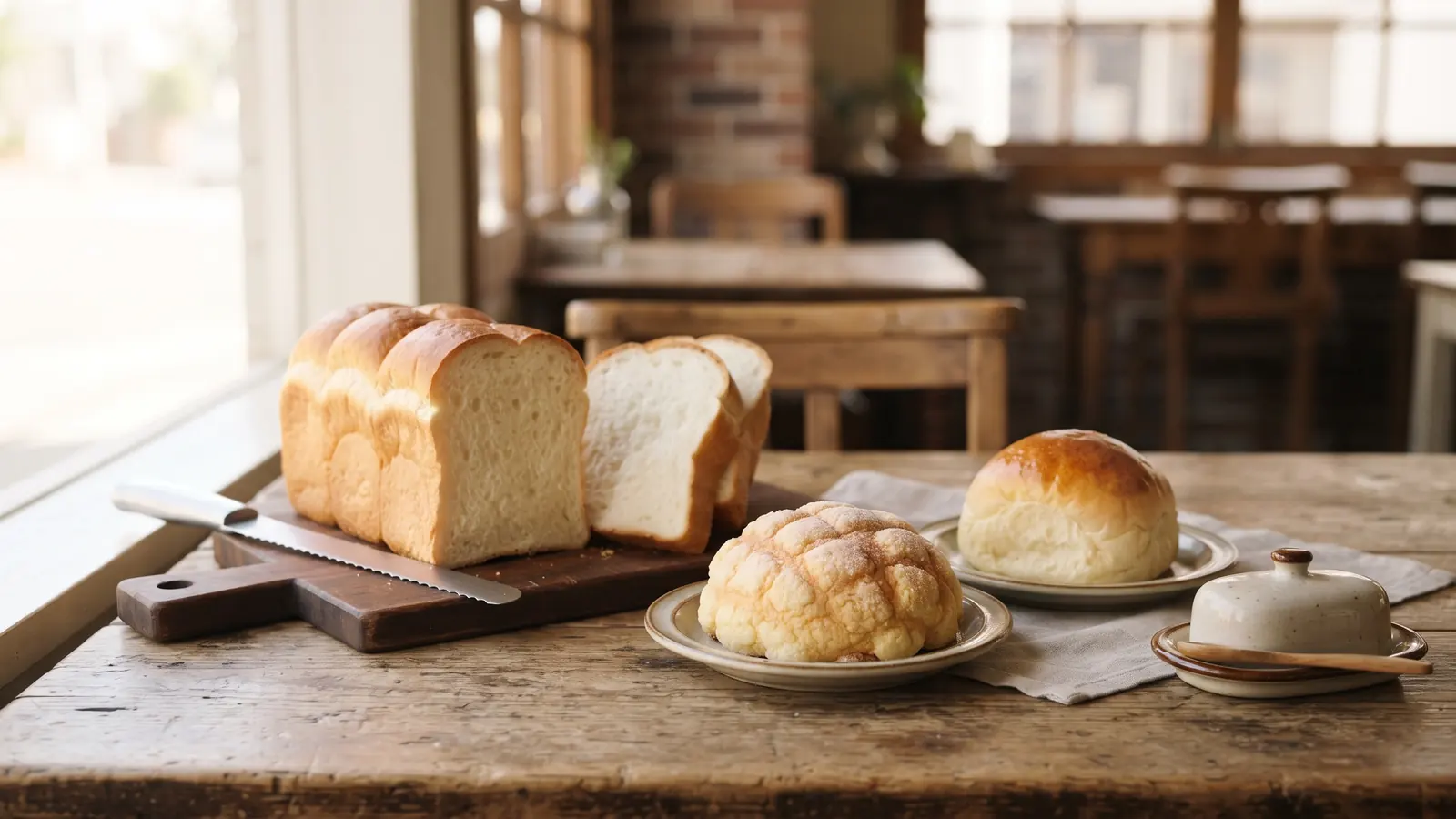
Short answer
A shokupan recipe makes a soft milk bread loaf from bread flour, milk, butter, sugar, yeast and a cooked flour paste. Knead until smooth, proof twice, shape three rolls in a tin and bake at 180 degrees C until golden.
A shokupan recipe for home bakers starts with a cooked flour paste, then adds bread flour, milk, sugar, yeast and butter, and the dough is kneaded smooth, proofed twice and baked in a loaf tin at about 180 degrees C. The result is a soft, springy Japanese milk bread loaf that slices cleanly and toasts well.
What do you need to make shokupan?
Shokupan needs bread flour, milk, sugar, salt, instant yeast and butter, plus a little extra flour and liquid for the paste. A standard 20 cm loaf tin or a lidded pullman tin works.
This recipe makes one loaf in a tin about 20 by 10 cm.
- 280 g bread flour
- 20 g plain flour, plus 40 ml boiling water, for the paste
- 150 ml milk, at room temperature
- 25 g caster sugar
- 5 g salt
- 4 g instant dried yeast
- 25 g soft butter, plus extra for greasing
Weigh ingredients on kitchen scales, because cups vary and the dough hydration matters. Use a thermometer if possible, aiming for dough that finishes near 26 to 28 degrees C.
How do you make the paste?
The paste, called yudane, is made by pouring boiling water over a small amount of flour and letting it cool, and it helps the loaf hold moisture and stay soft. This is the Japanese cousin of the tangzhong method.
- Place 20 g of plain flour in a small bowl.
- Pour over 40 ml of boiling water and stir until thick and smooth.
- Cover and cool completely, at least 30 minutes, or leave in the fridge overnight.
The paste should look like thick, glossy porridge. Use it cold, never warm, or it will start the yeast too fast.
How do you make and knead the dough?
Mix the bread flour, sugar, salt, yeast, milk and cooled paste into a rough dough, rest it briefly, then knead until it is smooth and elastic before adding the butter. The butter goes in last so the gluten forms first.
- Combine all ingredients except the butter and mix until no dry flour remains.
- Knead for about 8 minutes in a stand mixer, or 15 to 20 minutes by hand.
- Add the butter in two pieces and knead another 6 to 8 minutes.
- Test with the windowpane method: stretch a small piece, and it should become thin and translucent without tearing.
The dough will be sticky at first. Avoid adding extra flour, which makes the loaf dense.
How long should shokupan dough proof?
The first proof takes about 60 to 90 minutes at room temperature, until the dough has doubled. The second proof, after shaping, takes about 45 to 60 minutes and ends when the dough reaches the rim of the tin.
Proofing time depends on the room. A warm kitchen speeds things up, and a cool one slows them. Press a floured finger gently into the dough: if the dent springs back slowly and leaves a small mark, it is ready. If it springs back at once, give it more time.
How do you shape the loaf?
Divide the dough into three equal pieces, roll each into a ball, rest for 15 minutes, then flatten, fold into thirds and roll into a short log. Place the three logs side by side in the greased tin.
- Divide, shape into balls and cover for 15 minutes.
- Flatten each ball into an oval, fold the sides to the centre and roll up tightly.
- Lay the three rolls seam side down in the tin.
- Cover and proof until the dough is about 1 cm from the rim for an open tin.
Shaping in three pieces gives the loaf its pull-apart, layered slices and an even crumb.
How do you bake shokupan?
Bake shokupan in an oven preheated to 180 degrees C for 30 to 35 minutes, until the top is a deep golden brown. Tip the loaf out of the tin as soon as it leaves the oven.
| Tin type | Setup | Result |
|---|---|---|
| Open loaf tin | Bake uncovered | Domed top, golden crust |
| Lidded pullman tin | Slide on the lid after proofing | Square block, pale crust |
| Open tin, tented | Cover with foil if browning too fast | Even colour |
Brush the top with a little melted butter for a softer crust. Cool on a wire rack for at least an hour before slicing.
What problems can go wrong with shokupan?
The common problems are a dense crumb, a collapsed top and a pale crust, and each has a clear cause. Most trace back to kneading, proofing or oven temperature.
- Dense crumb: under-kneading or too much flour added during kneading.
- Collapsed top: over-proofing, so the dough rose too far before baking.
- Pale crust: the oven was not hot enough, or the loaf came out too early.
- Gummy middle: the loaf was sliced while warm, or it was underbaked.
When troubleshooting, change one variable at a time so the cause stays clear.
Does Dua Bakehouse publish a shokupan recipe?
Dua Bakehouse in Collingwood, Melbourne, does not publish a shokupan recipe in any source read for this guide. The bakehouse bakes its own shokupan, described in press coverage as soft Japanese milk bread served as thick slices with butter and preserves, and the recipe on this page is a general home method, not the bakehouse’s own.
Anyone who would rather taste it than bake it can check the menu page for the items recorded and the hours and location page for opening times. No price was published. This independent guide cannot take orders, so contact the cafe through its Instagram page or phone.
How do you serve homemade shokupan?
Serve homemade shokupan in thick slices, toasted lightly and spread with butter, or use it for sandwiches and french toast. A fresh loaf is at its best the day it is baked.
Slice about two to three centimetres thick, toast until the edges colour, and add butter or jam. Once cooled, the loaf keeps in a sealed bag for two to three days. For longer storage, freeze slices individually and toast them straight from frozen.
Common questions
Can I make shokupan without a stand mixer?
Yes, but it takes patience. Knead by hand for 20 to 25 minutes, using a slap-and-fold technique and a lightly floured bench. The dough is sticky at first and smooths as the gluten develops.
Do I need a pullman tin for shokupan?
No. An ordinary loaf tin works. You will get a domed top instead of a square loaf, but the soft crumb is identical. A lidded tin only changes the shape.
Why did my shokupan collapse after baking?
It was probably over-proofed, so the structure could not hold. Stop the final proof when the dough reaches about 90 percent of the tin height, and bake straight away.
Can I use plain flour instead of bread flour?
You can, but the loaf will be less tall and slightly less springy. Bread flour has more protein, which builds the gluten that supports a light, high loaf.
How do I slice shokupan neatly?
Let it cool completely, at least an hour, then use a long serrated knife with a gentle sawing motion. Cutting a warm loaf compresses the soft crumb and makes it gummy.
This page is part of the independent guide to Dua Bakehouse, which has the address, hours and menu.
This article is general information from an independent guide, not from Dua Bakehouse itself. For the store’s current details see hours and location.